Modern VMI Tips Newsletter: Building AI Data Centers? Here’s How Contractors & Distributors Can Boost Profitability With Data-driven VMI
If you're in construction today—especially in the world of AI-driven data centers—you’re standing right in the middle of the strongest economic tailwind of the last century. Demand is off the charts. Timelines are compressed. Material is moving faster than ever.
So if you’re a contractor or a distributor supplying these massive builds: congratulations, and buckle up.
But here’s the irony:
- When times are booming, no one slows down long enough to optimize costs.
- And when times slow down, no one wants to spend money to save money.
Somewhere in that chaos, profitability quietly erodes.
This week’s edition of Modern VMI Tips is for the contractors building AI facilities and the distributors supplying them. If you still care about controlling material costs—especially as bid margins tighten—here’s the truth:
Every dollar you save on inventory is worth seven or eight dollars of revenue. And if your margins are razor thin? That savings might be worth ten.
That’s why a data-driven vendor-managed inventory (VMI) system—supported by the right app—can be one of the most powerful profit tools on a job site, tracking job costing, consigned inventory, and more.
Let’s break down how to use VMI to improve your profitability.
1. Start With Consigned Conex Trailers
Reduce capital outlay. Increase visibility. Simplify logistics.
On large-scale data center jobs, material flow is relentless. Electricians, cablers, techs, HVAC, fire, and plumbing crews all pulling from their stock. What happens when material management fails with stockouts and overstock? Slips, delays, rework, and profit that evaporates.
A consigned conex with a VMI tracking app solves that.
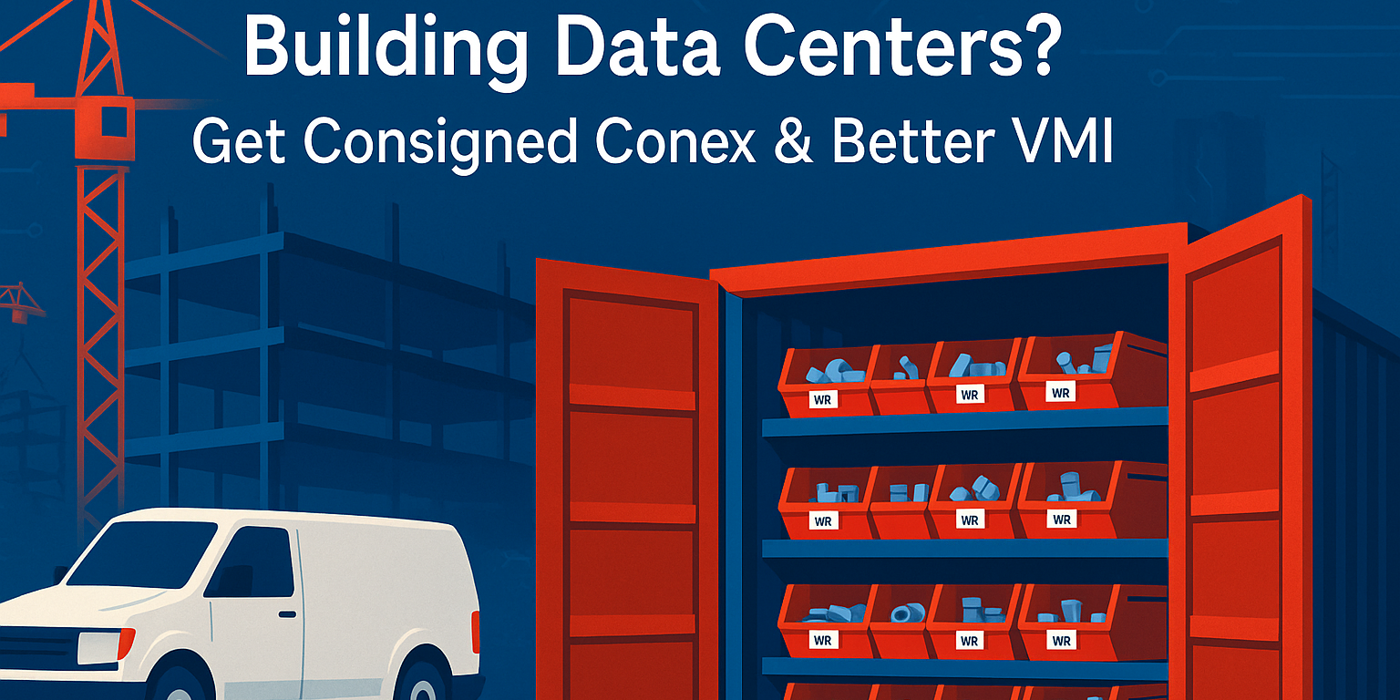
Distributors drop a loaded conex trailer on-site—stocked with everything from fasteners to cable reels—but the contractor doesn’t pay until they use the material.
With TrackStock (or any VMI app worth its salt), you can be live and tracking usage in under 30 minutes.
Why it matters:
- You only pay for what you actually use.
- You eliminate “mystery shrinkage” inside the jobsite free-for-all.
- You can send unused stock back for full credit at the end—instantly improving job profitability.
- Replenishment orders are sent immediately, while billing is consolidated for simplicity.
If you want to insulate your margins on large projects, this is the lowest-hanging fruit there is.
"I don't see how you could track consignment inventory with any degree of accuracy and ease without the eTurns VMI app." -- @jasonbarron, Field Operations Manager, M&L Electrical
2. Use Data-Driven Replenishment of Contractor-Owned Material
Min/max settings are great… until they’re wrong.
Most contractors think they’re “doing VMI” because someone from the distributor comes out once a week, eyeballs a shelf, and writes down what looks low.
Here’s the problem: Human intuition is the most expensive replenishment method on Earth.
A VMI app eliminates the guesswork.
With TrackStock customer-managed inventory (CMI), contractors can:
- Scan usage as it happens
- Have repenishment triggered automatically by the app
- Keep dynamically optimized min/max levels using actual pull history
Most contractors are shocked when they see TrackStock’s Min/Max Dashboard analytics for the first time. It clearly shows:
- Where they’re over-ordering
- Where usage is spiky
- Which items should be stocked deeper
- Which items are tying up unnecessary capital
- How much you could save from reduced carrying costs
For distributors, optimized min/max settings mean fewer emergency runs and cleaner replenishment routes. For contractors, it means spending less on inventory without increasing risk.
"The Min/Max Tuning dashboard has been critical for us in identifying areas for optimization for us and our customers. We're able to maintain inventory levels much more efficiently since we have a dedicated tool to better analyze usage trends and reduce inventory/stockouts/carrying costs." – Tom Rapisardo, E-Business Analyst, Graybar
3. Use the VMI System for Job Costing—Automatically
You can’t run profitable projects without clean cost attribution.
Most contractors still track job costing with:
- Paper tickets
- Excel sheets
- Foreman notes
- Hail-Mary end-of-month reconciliations
You already know this leads to friction, bad billing, and material write-offs.
A data-driven VMI replenishment app fixes that instantly.
When an electrician, installer, or tech pulls an item from inventory, they can assign it to:
- A specific floor
- A zone or cage
- A project phase
- A cost code
- A specific room (common in big data center builds)
And TrackStock automatically pushes that data into the contractor’s ERP so job costing happens without re-entry or error, keeping projects within budget.
Meanwhile, the distributor receives replenishment orders as soon as item minimums are breached.
This matters even more when you’re using lot-numbered cable reels, where apps like TrackStock track the spool by lot number and deduct footage used per job.
For finance teams, it’s a dream. For PMs, it’s the end of “where did that material go?” For distributors, it shows you are providing contractors with a differentiated VMI program that has measurable value.
If you care about profitability, you need this level of accuracy.
4. Add Tool Check-In/Check-Out + Asset Maintenance
Tools walk. Work stops. Accountability is priceless.
Let’s be honest: tools go missing constantly on large construction sites.
A VMI app with tool tracking solves that by letting teams:
- Scan tools out to a person or crew
- See who had the tool last
- See what tools anyone has
- Restrict check-out if a tool is due for maintenance
- Track asset life, calibration, and repairs
This doesn't just reduce theft—it reduces downtime.
A foreman shouldn’t spend 45 minutes asking “who’s got the hammer drill?” A PM shouldn’t discover a scissor lift went three months past inspection.
Tool tracking closes these gaps and reduces expensive idle time on fast-paced data center sites.
5. Sync Warehouse and Truck Inventory
Because field crews always grab the wrong reel unless you track it.
One of the biggest blind spots in construction is the disconnect between:
- Warehouse inventory
- Jobsite inventory
- Truck inventory
As our wire/cable management guide points out, syncing warehouse and truck inventory with a mobile CMI app eliminates guesswork and increases visibility across all locations.
When using distance-marked cable reels from Cerrowire, Southwire, Belden and others, you can track remaining wire footage in the app without manual checks, ensuring accuracy on every pull and triggering replenishment orders automatically.
For contractors, this means:
- No more “phantom reels”
- No lost material between jobsites
- No buying duplicates because you didn’t know what was in the trucks
For distributors, it reduces emergency restocks and field confusion.
Why This Matters Even in a Boom
With AI data centers popping up everywhere, it can feel like cost efficiency doesn’t matter.
But this boom won’t last forever. Margins will tighten. Material inflation will stabilize. Backlogs will thin. The contractors and distributors who thrive long-term will be the ones who built operational discipline during the frenzy—not after.
And again, here’s the simple math:
If you save $100,000 in material, that’s equivalent to generating $700,000–$800,000 in new revenue.
No hustle required. Just smarter material management.
Key Takeaways
Saving money is one of the easiest ways to make money—especially when you’re in full control of your material management process.
The right VMI system helps you:
- Hold less inventory
- Waste less material
- Reduce carrying costs
- Improve job costing
- Increase trust between contractor and distributor
- Strengthen margins—quietly, consistently, automatically
In today’s market, success isn’t about holding more material. It’s about holding the right material, in the right place, at the right time— and proving it with clean data.
If you want to see how contractors and distributors are using TrackStock to stay profitable while building some of the largest AI facilities in the world, reach out.
Onward. —Rock