What Is MRO Inventory Management? Methods and Benefits

Key Takeaways
-
MRO inventory includes the indirect parts and supplies that keep production equipment running.
-
When MRO items run out, downtime follows.
-
Mobile apps and inventory sensors provide hands-off visibility and auto-replenishment that keep materials stocked and production consistent.
-
The right MRO inventory replenishment app keeps MRO consumables in stock while reducing labor, carrying costs, and downtime.
What Is MRO Inventory?
MRO stands for Maintenance, Repair, and Operations. These are the indirect materials that support production rather than become part of the final product. Manufacturers depend on MRO supplies to keep machines operational and facilities safe.
Examples include lubricants, filters, fasteners, gloves, adhesives, and janitorial supplies. These parts are often considered C-class items because they are low-cost but critical to uptime. When a filter, gasket, or pair of safety gloves isn’t available, maintenance stops, and production can stall.
While enterprise resource planning software (ERP) tracks direct production parts, most companies still manage their MRO inventory manually or with limited automation. That lack of visibility can lead to stockouts, rush orders, and higher operational costs. There is a better way.
For more context, see MRO Inventory Management: Moving from VMI to CMI.
What Is MRO Inventory Management?
MRO inventory management refers to the process of tracking, replenishing, and forecasting the parts that keep machinery and facilities running. The goal is to prevent stockouts while avoiding overstocking.
Common challenges include:
-
Reactive replenishment or “ordering when empty”
-
Inaccurate counts or spreadsheets
-
Excess capital tied up in rarely used parts
-
Delays between usage and reorder triggers
-
Tool cribs for doing the maintenance that don’t have a check-in/check-out process for accountability
An effective MRO strategy helps manufacturers maintain consistent availability while lowering costs. Modern approaches combine mobile apps, sensors, data visibility, and auto-replenishment to make this possible.
MRO Inventory Management Example
Watch how Honeywell uses eTurns TrackStock to manage indirect materials with full traceability, automated reporting, and faster inventory transactions across its aerospace facility.
Methods of MRO Inventory Management and Cost Benefits
Manufacturers, e-commerce distribution centers, and others manage MRO inventory in several ways, each with its own level of visibility, labor requirement, and cost efficiency.
The right approach depends on your environment, part velocity, and available labor for doing cycle counts or usage tracking.
Managing MRO Inventory with Mobile Scanning Apps
Mobile MRO inventory management apps like TrackStock let teams scan barcodes or QR codes to track usage, perform cycle counts, and trigger auto-replenishment with min/max settings. They are faster and more accurate than managing inventory with spreadsheets or clipboards, and they support both Vendor Managed Inventory (VMI) and Customer Managed Inventory (CMI) programs.
Mobile VMI apps work well when the objective is to digitize counts, shorten ordering time, and provide usable consumption data. However, they still depends on human input, which means that gaps can occur between scans or mistakes can be made if users don’t follow the guidance provided by the app. For higher-volume environments or frequently used parts, that can still mean downtime.
Managing MRO Inventory with Electronic Shelf Labels
Electronic Shelf Labels, or eLabels, are an entry-level sensor inventory management solution for MRO consumable inventory. They are a more automated way to replenish than mobile scanning apps, but they can only be used for triggering a replenishment order, not for tracking quantity-on-hand as you can do with mobile scanning apps or weight sensors.
eLabels display relevant product information and min/max levels electronically on the label and have a button to push when a user visually sees that the quantity on hand is below the minimum level. One push of a button triggers a digital replenishment order, with the correct packaging quantity up to the maximum level, through the TrackStock app and off to the correct distributor. Multiple button pushes do not trigger multiple orders. Integration with a distributor’s ERP system allows the eLabels to display order feedback such as “on order”, “backordered” or “shipped”.
Managing MRO Inventory with Sensors and SmartShelves
Sensor technology takes replenishment to the next level of automation. Using SmartShelf or SensorBins weight sensors under bins or palettes of product manufacturers can monitor stock levels continuously without human intervention and do data-driven auto-replenishment.
SensorBins automatically track the weight of bins containing MRO consumables. When the bin weight falls below a defined minimum threshold, the system sends a reorder signal through TrackStock to the supplier.
This approach eliminates manual counting and ensures that supplies like gloves, filters, or fasteners are always available. It’s particularly effective for high-volume consumables or critical maintenance parts.
Benefits include:
-
Near real-time visibility into current stock
-
Fewer stockouts and production interruptions
-
Reduced labor for counting and ordering
-
Lower carrying costs from leaner inventory levels
In many cases, manufacturers see up to 73% reduction in carrying costs and 90% lower procurement costs through automating replenishment. Learn more in No-Touch Medical Inventory Management: It’s Possible with IoT Sensors.
Managing MRO Inventory with Vending Solutions
Some facilities use vending systems or automated cabinets to distribute MRO parts. These solutions track usage by user and provide accountability for higher-value tools or safety items. Vending solutions are the most expensive inventory management solution and are only appropriate when controlled access is of paramount importance and the cost of shrinkage or the high-value tool justifies the cost of the vending machine.
Choosing the Right MRO Inventory Management Method
When deciding which MRO management method to use, consider:
-
Volume and velocity – High-turn parts are best suited for more automated replenishment solutions.
-
Labor availability – If your team is stretched thin, inventory sensor solutions remove manual counting or usage tracking tasks.
-
Physical environment – Ensure technology can handle dust, vibration, or temperature fluctuations.
-
Integration needs – Solutions that connect to your ERP or supplier portals streamline adoption and reporting.
Ultimately, the best system depends on your goals: if accuracy, uptime, and reduced labor are top priorities, automation with sensors provides the greatest long-term ROI.
Rollout Strategy and ROI Snapshot
Transitioning to automated MRO inventory management doesn’t need to be complicated. The most successful implementations start small, measure results, and scale up as savings become clear.
Start with a pilot. Choose one department or a limited range of parts to test automation. Track metrics such as stockout frequency, order turnaround, and hours spent on manual counting.
Monitor and measure. Compare before-and-after results. Many manufacturers see measurable improvements within the first 60 days, especially in labor reduction, reduced stockouts, and accurate replenishment.
Expand gradually. Once ROI is proven, roll out the system to additional storage areas or facilities. Scaling this way minimizes disruption and builds internal confidence in the process.
The return on investment typically comes from three core areas:
-
Reduced downtime through consistent part availability
-
Lower carrying costs from leaner, data-driven stocking levels
-
Labor savings from less manual tracking and ordering
Running out of a small part can quickly become costly. For example, ten hours of downtime at $1,000 per hour equals $10,000 in lost production time. Over a year, that’s $120,000, far exceeding the cost of implementing an automated system.
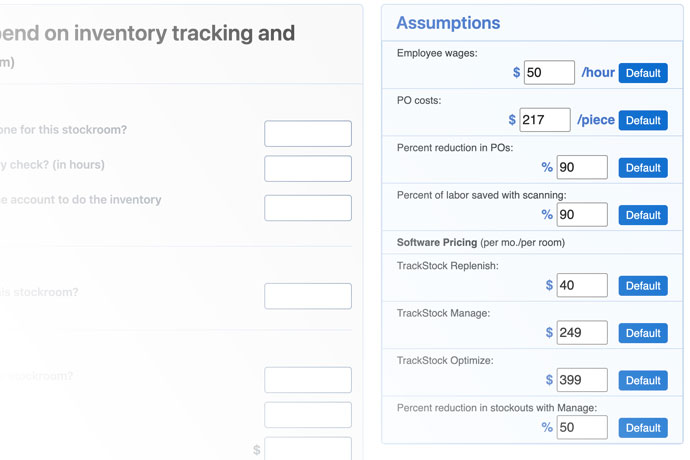
Calculate Your Inventory ROI
Use the eTurns TrackStock ROI Calculator to see how SensorBins can reduce your labor costs and quickly deliver ROI.
MRO FAQs
Sensors continuously track stock levels and automatically reorder when supplies fall below a preset minimum. That ensures maintenance staff always have the parts they need before shortages occur.
Yes, eLabels are being used in medical refrigerators for replenishment of medicines, and they work great.
In addition, eight-based inventory sensors like eTurns SensorBins handle weights from 0.012 ounces up to 3,200 pounds and can function in various conditions. The key is selecting hardware suited for the temperature, vibration, and dust levels in your facility.
Start by identifying average downtime costs, inventory carrying costs, and labor hours spent on manual counts. Then measure improvements after automation. Many eTurns customers report a combination of reduced downtime, lower carrying costs, and fewer emergency orders that together produce a strong ROI.